
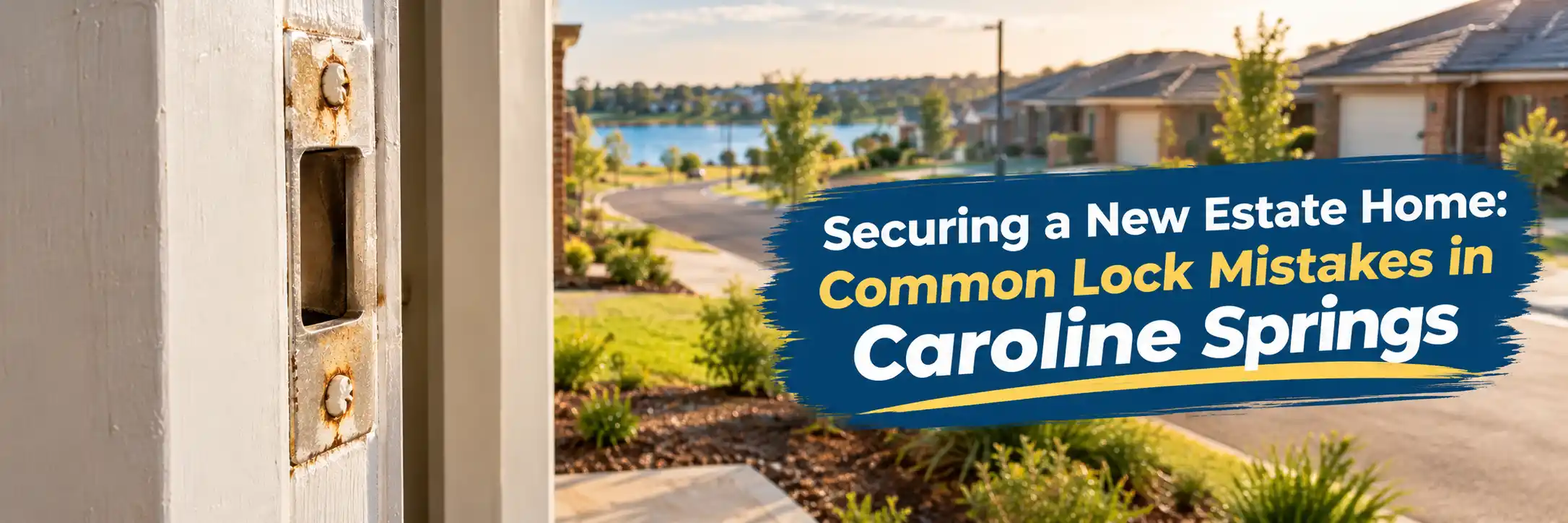
Caroline Springs is unlike most Melbourne suburbs. Developed entirely on greenfield land since 1999, every home in the suburb arrived with builder-installed hardware, developer-specified cylinders, and construction-phase key histories.
There are no century-old heritage homes here with original mortice locks. There are no Victorian terraces with unknown key histories stretching back decades. What there is: a suburb-wide cohort of homes where the security gaps are predictable, consistent, and mostly the same.
New estate lock mistakes Caroline Springs residents make aren’t random. They follow a pattern — because the housing stock follows a pattern. Understanding the pattern is most of the fix.
Mistake 1: Assuming New Means Secure
The most common and most consequential mistake. A brand-new home in Caroline Springs has lock hardware that was installed to satisfy the National Construction Code minimum compliance requirement. This is not the same thing as a security specification.
The NCC sets a floor. Locks must function. They must meet basic residential performance standards. They must pass the compliance inspection. The NCC does not require Australian Standard AS 4145.2 high-security ratings. It does not require anti-pick, anti-drill, or anti-bump cylinders. It does not require restricted key blanks.
Delfin’s masterplanned community design produced excellent parks, lakes, and streetscapes. It produced standard residential hardware. The two aren’t related. A home that looks secure — new, clean, just moved into — and a home that is secure are different things when the cylinder is builder-grade.
Mistake 2: Not Asking About the Construction Cylinder
Every Caroline Springs home has a construction history. The building process involves site managers, subcontractors, certifiers, and inspectors — all of whom needed access to the property at various points during construction. Whether the cylinder in your front door today is the same one that was installed during construction, or whether it was changed at handover, is a question most Caroline Springs homeowners never ask.
The correct question to ask before or at settlement: ‘Was the cylinder changed between construction completion and handover, and can this be confirmed in writing?’
A builder who handles this systematically provides the confirmation quickly. One who can’t confirm it is telling you that the construction-phase key history may still be active.
The fix is simple: a cylinder rekey or replacement at settlement. It costs less than a dinner out and closes whatever came before.
Pro Tip:
Request your builder’s handover checklist at settlement and check for any reference to lock or cylinder status. Well-run estate developers maintain this documentation. If yours doesn’t include it, ask specifically — the absence of documentation about cylinder status is itself useful information, and it tells you a rekey is warranted before you spend your first night in the property.
Mistake 3: Ignoring the Strike Plate
The most significant security gap in Caroline Springs’ new estate homes is not the cylinder. It’s the strike plate.
A standard builder-grade strike plate — the metal plate on the door frame that the deadbolt engages with — is secured with two or three screws of 30-35mm length into the surface timber of the door jamb. Under the force of a kick or shoulder charge, these screws pull out of the timber before the lock itself is defeated. The door opens. The cylinder survives intact.The house is entered.
This is the dominant residential break-in method in Melbourne’s western suburbs. Not lock picking. Not cylinder drilling. A kick at the door.
A reinforced strike plate — heavier gauge steel, extended screw positions — secured with 75mm or longer screws that anchor into the structural stud behind the jamb distributes the force into the house’s structural framing rather than two short screws in surface timber. The improvement in forced-entry resistance is substantial. The visual change is zero. The cost is trivial.
Most Caroline Springs homeowners have never thought about their strike plate. Most still have the builder-grade original. This is the fix with the highest return of any security upgrade available in the suburb.
Mistake 4: Leaving the Back Door Hardware Unaddressed
Caroline Springs’ homes are masterplanned but not uniformly specified. The hardware on the front entry — the door that faces the street, that’s visible at inspection, that the builder knows will be noticed — is typically reasonable. The hardware on the rear entry gets whatever the specification called for at minimum.
In many Caroline Springs homes, the rear entry has a keyed lever handle with integrated locking but no separate deadlock. The lever handle provides resistance to casual opening; it doesn’t provide the 25mm bolt throw into a strike plate that a quality deadlock does.
A side-by-side hardware comparison:
- Front entry: deadlock with 25mm+ bolt throw, builder-grade cylinder, standard strike plate
- Rear entry: keyed lever handle, integrated locking, no separate deadlock, standard or no strike plate
The rear yard of a Caroline Springs home — bounded by fencing with a side gate — is accessible with varying degrees of effort depending on fence height and gate hardware. Once in the rear yard, the rear entry is the next barrier. If that barrier is a keyed lever handle with no deadlock, the security picture for the whole property is shaped by its weakest element.
Mistake 5: Standard Key Blanks on a Property That Needs Key Control
Caroline Springs’ estate homes use key blanks that are standard profiles — available at hardware stores, key kiosks, and any locksmith. Anyone who holds a key can copy it without any authorisation.
For a Caroline Springs family home where keys have been distributed to family members, school-age children, service providers, neighbours, and in some cases real estate agents during a sale or rental period, the number of working copies in existence can significantly exceed the household’s knowledge. None of the extra copies are traceable.
Restricted key blanks — profiles available only through the authorising locksmith, requiring documented permission for duplication — address this structurally. The key history stops accumulating through informal copying. When a key is lost or a keyholder changes, the response is a documented event rather than an estimated guess.
A cylinder upgrade to a restricted-blank system can be done at the same visit as a rekey. The household gets a fresh key history and key management control in one visit.
“Caroline Springs jobs have a consistency that other suburbs don’t. The whole suburb was built in essentially the same era to essentially the same specification. The strike plate is almost always the same. The back door hardware is almost always the same gap. The construction cylinder question is almost always unanswered. Once you’ve done enough jobs in the suburb you know what you’re going to find before you arrive.”
Mistake 6: The Garage Connecting Door
Caroline Springs’ family homes include attached or integral garages as standard. The door between the garage and the house interior is the connection that most homeowners treat as internal. It isn’t.
The automatic garage door is the outer barrier. Once it’s opened — whether by legitimate remote, a defeated emergency release, or simply being left open — the connecting door to the house is the next layer. In most Caroline Springs homes, that layer is a passage knob. It has no deadlock. It provides seconds of resistance.
Fitting a quality deadlock to the garage connecting door — same specification as the front entry — is the upgrade that addresses this specific gap. Combined with an emergency release shield on the automatic garage door (which prevents the release cord from being tripped externally through the header gap), it closes a vulnerability that Caroline Springs’ standard construction left open.
Warning:
Caroline Springs homeowners with homes in Owners Corporation (OC) governed developments — the townhouse and villa precincts within the suburb — should confirm with their OC whether the entry door configuration requires approval before any hardware modification beyond a like-for-like cylinder rekey. City of Melton’s planning zones include Comprehensive Development Zone (15%) and Residential Growth Zone (9%) precincts where OC governance is more likely to apply. Check before engaging a locksmith for any change beyond rekeying.
Mistake 7: Never Scheduling a Security Review
Caroline Springs’ oldest homes were built in 1999. That makes them 25 years old. Hardware that was builder-grade at installation in 1999 has had 25 years of daily use. Australian Standard AS 4145.2 didn’t exist in its current form in 1999. The security context of Melbourne’s western suburbs in 2025 is different from 1999.
A security review for any Caroline Springs home that hasn’t had hardware assessed since purchase or settlement:
- Test every external lock — key operation, deadbolt throw, window latch engagement
- Check strike plate anchoring on all external doors
- Assess garage connecting door hardware
- Confirm key count — how many working copies exist for each cylinder
- Review window latch condition on aluminium sliding windows
These checks take less than an hour. The findings almost always include at least one gap that hasn’t been thought about since the property was built.
The Caroline Springs Masterplanned Legacy
Caroline Springs won Australia’s Best Masterplanned Community Award in 2006 — recognition for design quality, infrastructure, and liveability. That masterplanning excellence produced Lake Caroline, the CS Square hub, Kororoit Creek parklands, and integrated walking trails. It produced builder-grade residential hardware.
The distinction matters: excellent urban design and adequate residential security hardware are separate decisions made by different people at different project stages. The former is about liveability; the latter is about NCC compliance. Caroline Springs excels at liveability. The hardware gap is structural to how Australian residential construction works — not specific to this suburb, but particularly visible here because the housing stock arrived at the same time to the same specification.